The preparation of raw materials is the first step in weaving an Iranian carpet. Therefore, before making a kilim (flat-woven rug) or any Iranian carpet, carpet-weaving yarn must be produced, and the wool obtained must be dyed using appropriate colors. Additionally, the yarn needed for decorating the carpet must also be dyed properly.
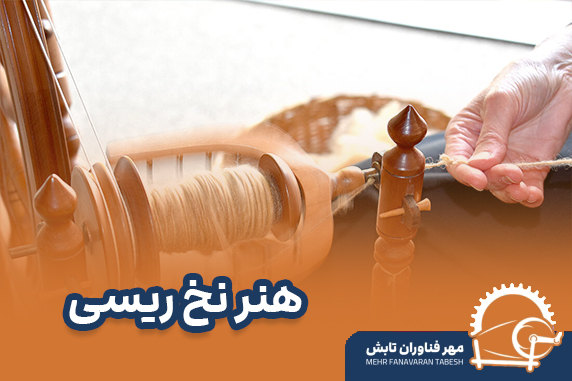
The wool sheared and cleaned from flocks of sheep must be spun. Wool spinning, at its most basic level for nomadic carpets, is done using a stone, a small piece of wood, and a spindle. At a more advanced level, for urban carpets, it is done with a manual spinning wheel or an automatic spinning machine. The hand-spun yarn is made into skeins. In the traditional method, one end of the yarn is tied around a stone, then it is spun in a circular motion around the head, which slowly twists the wool into carpet yarn. Many nomadic tribes still use this method today.
A structural detail often noted in professional carpet analysis is the direction in which the wool fibers are spun and twisted. If the wool is spun counterclockwise, it is called an “R twist,” meaning the yarn has been spun to the right. An “S twist,” on the other hand, means the yarn has been spun to the left, following the clockwise direction. Spun yarn is usually twisted in the opposite direction of the spin to form a skein. The effect of hand-spun wool is easily recognizable in most carpets.